
Electric Motor Adhesive: The Right Bonding Solution for Reliable Motor Performance
Reading Time: 8 minutesElectric motor adhesive plays a vital role in modern motor manufacturing. From bonding magnets and laminations to securing coils, bearings, and housings, the right adhesive for electric motor applications helps improve strength, durability, heat resistance, and overall efficiency. In high-speed and high-vibration environments, electric motor adhesives are often more reliable than mechanical fastening alone because they distribute stress evenly, reduce part movement, and support compact motor design.
As motors become smaller, faster, and more powerful, the need for advanced adhesives for electric motors continues to grow. Whether it is a DC motor, induction motor, brushless motor, or stepper motor, each motor contains critical parts that need secure bonding, insulation, sealing, or thermal management. ThreeBond offers a wide range of electric motor adhesive solutions that help manufacturers improve performance and production reliability.
Why Electric Motor Adhesive Matters
Motors are exposed to heat, vibration, centrifugal force, electrical load, and continuous movement. A simple fastening method is often not enough to protect delicate assemblies over time. It helps solve these challenges by creating strong bonds between different components while also providing thermal resistance, chemical resistance, and electrical insulation.
In many motor applications, adhesives for electric motors help reduce the number of mechanical parts needed in assembly. This can make the motor lighter, more compact, and easier to manufacture. Adhesives also help maintain alignment, prevent fraying, lock components in place, and protect the motor from dust, moisture, and vibration.
Key Applications of Adhesive for Electric Motor
An adhesive for electric motor manufacturing is used in many parts of the assembly process. The most common applications include:
Coil winding and insulation
Coil windings must stay in place and remain protected from movement and fraying. Electric motor adhesives help secure the winding structure while improving heat resistance and electrical insulation. This is especially important in motors that operate for long hours or under high load.
Stator core bonding
The stator core must remain stable under vibration and heat. This adhesive can bond laminated steel sheets together and support strong structural integrity. This improves reliability and helps reduce noise and movement during operation.
Magnet bonding
Permanent magnets in rotor assemblies must resist centrifugal force and thermal expansion. Electric motor adhesives are used to secure split magnets and ring magnets so they remain fixed even under demanding operating conditions.
Bearing and shaft bonding
Bearings and shafts require strong locking and alignment. Adhesives for electric motors can help prevent loosening, improve fit, and support long-term rotational stability.
Case sealing
Motor housings need protection from moisture, dust, oil, and contamination. These adhesive and sealant products help seal the case and protect internal components from environmental damage.
Rotor balancing
Rotor balance weights must remain in position at high speed. Electric motor adhesive ensures accurate placement and stable performance.
Fan and impeller bonding
In fan motors and brushless motor systems, adhesive is used to bond impeller blades, housings, and other rotating parts. This helps improve strength while supporting lightweight construction.
What Makes a Good Electric Motor Adhesive
The best adhesive for electric motor applications must perform under real operating conditions. Some important qualities include:
High heat resistance
Electric motors generate heat during operation, so the adhesive must remain stable at elevated temperatures.
Strong bond strength
The adhesive must hold parts firmly under vibration, shock, and rotational force.
Electrical insulation
Many motor parts must be insulated from each other to avoid leakage or short circuits.
Chemical resistance
Motor assemblies may face exposure to oils, fuels, solvents, and cleaning agents.
Flexibility
Some parts need a degree of flexibility to absorb stress caused by thermal expansion and vibration.
Fast curing
In production environments, fast-curing electric motor adhesives help reduce assembly time and improve throughput.
Low outgassing
For sensitive motor and electronic parts, low-outgassing formulations help reduce contamination risks.
ThreeBond Electric Motor Adhesives for Different Motor Types
ThreeBond develops electric motor adhesive solutions for a wide range of motor designs and components.
DC motor and universal motor applications
Based on the provided diagram, here is the detailed breakdown of ThreeBond products, their specific applications, and the corresponding motor parts for both brushed and induction motors.
1. Motor with Brush (DC, Universal)
| Part | Application | Product Name / Code |
| Commutator | Bonding with shaft | ThreeBond 1357K |
| Commutator | Coil fraying prevention | ThreeBond 2235L |
| Case | Case sealing and adhesive | ThreeBond 1535 Series |
| Choke Coil | Fixing | ThreeBond 1535 Series |
| Rotor | Balance weight | ThreeBond 3084 |
2. Induction Motor
| Part | Application | Product Name / Code |
| Case | Case sealing | ThreeBond 1160 ThreeBond 1226 |
| Bearing | Case and shaft bonding | ThreeBond 1357K |
| Stator Core | Adhesive lamination | ThreeBond 1360F |
| Coil Winding | Fraying prevention | ThreeBond 1224G ThreeBond 2285 |
| Screw | Fixing | ThreeBond 2400 Series (Pre-coated bolts / MEC) |
Summary of Applications
- Bonding & Fixing: Products like the 1357K and 2400 Series are used for mechanical stability, ensuring shafts, bearings, and screws remain secure during high-speed rotation.
- Sealing: The 1160, 1226, and 1535 Series provide essential environmental protection for the motor case, preventing the ingress of dust or moisture.
- Protection & Balancing: Specialty products like the 2235L and 2285 prevent wires from fraying due to centrifugal force, while the 3084 is used specifically to balance the rotor for smooth operation.
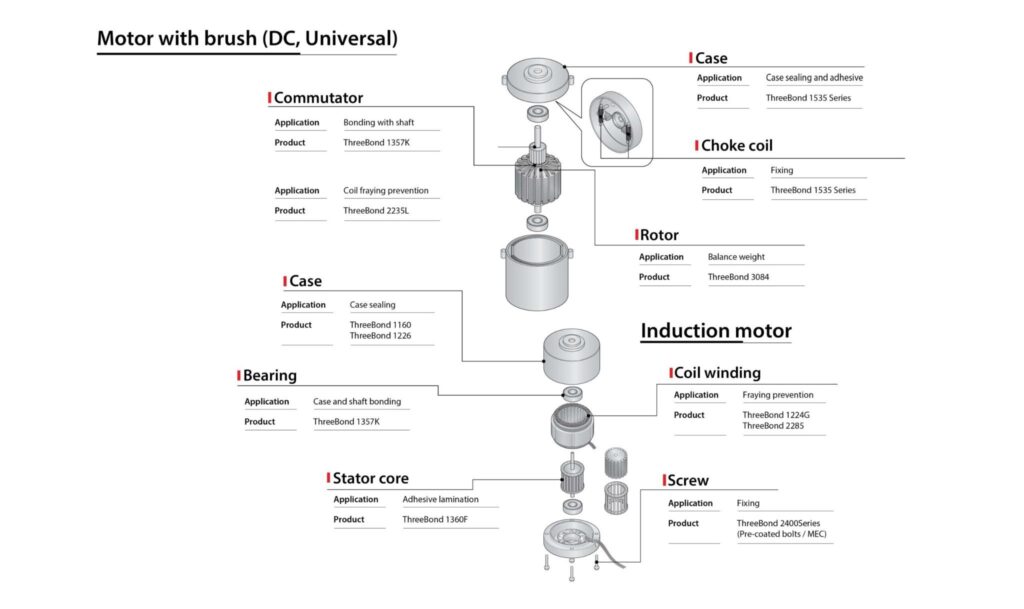
In brushed motor systems, adhesives are used for commutator bonding, case sealing, coil fixing, rotor balancing, and bearing locking. These applications require high heat resistance and stable bonding under continuous movement.
Induction motor applications
In induction motors, adhesive for electric motor use is commonly applied to coil winding, stator core bonding, screw fixing, and case sealing. The goal is to improve durability, prevent movement, and support long-term performance.
Brushless motor applications
Based on the provided diagram, here is a detailed breakdown of the ThreeBond products and their specific applications within motor manufacturing, categorized by the Inner Rotor and Outer Rotor models.
1. Inner Rotor Model
The inner rotor model features components where the magnetic assembly rotates inside the stator.
Case
- Application: Stator core bonding
- Products: * ThreeBond 2222P
- ThreeBond 2237J
Magnet
- Application (Split magnet bonding): * ThreeBond 2049/2149
- ThreeBond 3955
- Application (IPM motor magnet bonding): * ThreeBond 2280H
Stepper Motor
- Application: Burr prevention during rotor core cutting
- Products: * ThreeBond 3042
- ThreeBond 3057 Series
Control Board
- Application: Surface coating (for protection and insulation)
- Product: ThreeBond 3164D
2. Outer Rotor Model (Fan)
This model is typically used in cooling fans where the magnets rotate around the external perimeter of the stator.
Fan (Impeller, Blades)
- Application: Bonding with housing
- Product: ThreeBond 7737
Magnet
- Application (Split magnet bonding): * ThreeBond 2049/2149
- ThreeBond 3955
- Application (Ring magnet bonding): * ThreeBond 1357K
- ThreeBond 1375N
Bearing
- Application (Bonding with shaft): * ThreeBond 1357K
- Application (Bonding with central tower): * ThreeBond 7737
Summary Table of Products
| Product Code | Motor Model | Part Category | Application |
| ThreeBond 2222P / 2237J | Inner Rotor | Case | Stator core bonding |
| ThreeBond 2049/2149 / 3955 | Both | Magnet | Split magnet bonding |
| ThreeBond 2280H | Inner Rotor | Magnet | IPM motor magnet bonding |
| ThreeBond 3042 / 3057 Series | Inner Rotor | Stepper Motor | Burr prevention during rotor core cutting |
| ThreeBond 3164D | Inner Rotor | Control Board | Surface coating |
| ThreeBond 7737 | Outer Rotor | Fan / Bearing | Bonding with housing / central tower |
| ThreeBond 1357K | Outer Rotor | Magnet / Bearing | Ring magnet bonding / Shaft bonding |
| ThreeBond 1375N | Outer Rotor | Magnet | Ring magnet bonding |
Note: Several products, such as the 3955 and 2049/2149 series, are versatile enough to be used for split magnet bonding in both inner and outer rotor configurations.
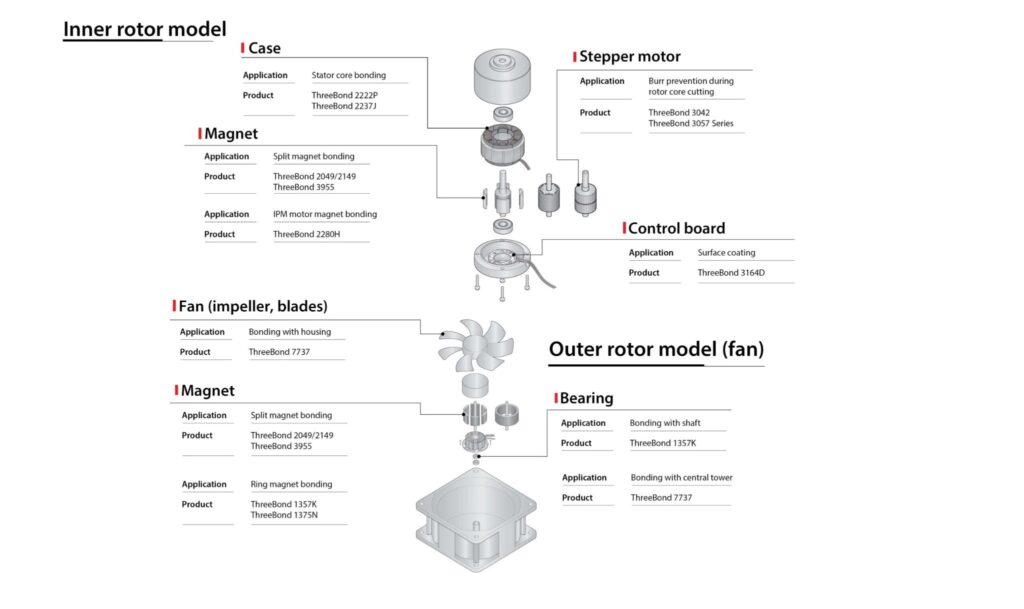
Brushless motors use adhesive in magnets, stators, control boards, bearings, and housing components. These motors often need compact design, accurate alignment, and strong resistance to vibration.
Stepper motor applications
Stepper motors need precise assembly. Electric motor adhesive helps with burr prevention, rotor core support, and structural stability in compact assemblies.
ThreeBond Product Types Used in Electric Motor Adhesive Applications
ThreeBond offers several product types that are suitable for adhesives for electric motors:
High-temperature epoxy adhesives
These are used where strong bonding and heat resistance are essential. They are ideal for stator core bonding, coil support, and structural motor parts.
Moisture-curing silicone adhesives
These adhesives provide flexibility, vibration resistance, and strong sealing performance. They are useful for case sealing, choke coil fixing, and motor protection.
Anaerobic adhesives
These are useful for metal-to-metal bonding, shaft locking, bearing support, and stator core lamination. They cure in confined spaces and offer high heat resistance.
Instant bonding adhesives
These are helpful for fast assembly of plastic and small motor parts where quick fixture strength is needed.
UV-curable adhesives
These are suitable for rotor balancing, surface coating, and applications that need automation-friendly curing.
Benefits of Using Electric Motor Adhesive
Using electric motor adhesive in motor design and manufacturing offers many practical benefits.
It improves structural stability by holding components firmly in place.
It helps reduce vibration and movement during operation.
It supports better heat dissipation in demanding environments.
It protects the motor from moisture, dust, and chemicals.
It allows more compact and lightweight motor design.
It increases production efficiency by reducing assembly time.
It helps improve reliability and service life in high-performance motors.
For manufacturers, adhesives for electric motors are not just a bonding material. They are an important part of the motor’s performance strategy.
Choosing the Right Adhesive for Electric Motor
Selecting the right adhesive for electric motor applications depends on several factors.
First, understand the part that needs bonding. A magnet, coil, bearing, rotor, or housing may each need a different adhesive formulation.
Second, consider the operating environment. If the motor faces high heat, vibration, moisture, or chemical exposure, the adhesive must be chosen accordingly.
Third, think about curing conditions. Some electric motor adhesives cure with heat, some with moisture, some under UV, and some at room temperature.
Fourth, match the adhesive to the production process. High-volume manufacturing often benefits from fast-curing or automation-friendly solutions.
Finally, make sure the adhesive provides the right balance of strength, flexibility, insulation, and durability.
ThreeBond Electric Motor Adhesive Solutions
ThreeBond provides adhesive solutions for many electric motor parts, including:
Stator core bonding
Coil winding fraying prevention
Magnet bonding
Bearing and shaft bonding
Rotor balance weight fixing
Case sealing
Control board coating
Fan and impeller bonding
Choke coil fixing
These electric motor adhesive solutions are designed to support performance, efficiency, and durability across different motor types. Whether the application requires structural bonding, sealing, insulation, or heat resistance, ThreeBond offers products suited to the need.
Final Thoughts
Electric motor adhesive is a critical part of modern motor manufacturing. As motors become more advanced, the need for reliable adhesive for electric motor assembly becomes even more important. From stators and coils to magnets and housings, adhesives for electric motors help improve strength, thermal control, electrical safety, and long-term performance.
ThreeBond electric motor adhesives are designed to meet the demands of DC motors, induction motors, brushless motors, and stepper motors. By using the right adhesive in the right place, manufacturers can build motors that are more durable, efficient, and reliable.
If you are looking to improve your motor assembly process, choosing the right adhesive can make a major difference in product quality and performance.
FAQs
1. What is electric motor adhesive used for?
Electric motor adhesive is used to bond, seal, insulate, and protect motor components such as coils, magnets, stators, bearings, shafts, and housings.
2. Why is adhesive for electric motor better than only mechanical fixing?
Adhesive for electric motor applications helps distribute stress more evenly, reduce vibration, improve insulation, and support compact motor design.
3. Which electric motor adhesives are best for high heat?
High-temperature epoxy adhesives and heat-resistant silicone adhesives are commonly used in electric motor assemblies that operate under elevated temperatures.
4. Can adhesives for electric motors help with vibration resistance?
Yes. Many adhesives for electric motors are designed to absorb vibration, prevent loosening, and improve long-term stability.
5. Where are ThreeBond electric motor adhesive products used?
ThreeBond electric motor adhesives are used in coil winding, magnet bonding, stator core bonding, bearing fixing, case sealing, rotor balancing, and control board protection.




Post a comment