

Adhesives and Sealants for Semiconductors
Semiconductor manufacturing and packaging rely heavily on advanced adhesives and sealants to bond components and protect circuits. Unlike rigid mechanical fasteners, adhesives can join silicon chips, metal carriers and insulating substrates while accommodating thermal expansion and vibration. For example, ThreeBond notes that epoxy resins “are used for chip-attach glues and die-encapsulation” in semiconductor packaging. By choosing the right adhesive or sealant, designers can improve thermal performance, moisture resistance and reliability in semiconductor devices.
Adhesives for Semiconductors: Bonding and Thermal Management
ThreeBond offers specialty adhesives engineered for semiconductor assembly and adhesives for electronics manufacturing. These include high-purity epoxy adhesives for die bonding and silicone adhesives for thermal interfaces. In power modules and microelectronics, thermally conductive adhesives dissipate heat: ThreeBond’s TB1225 silicone adhesive series, for instance, delivers 1.6–2.5 W/m·K thermal conductivity, bonding power ICs to heat spreaders. High-performance die-attach epoxies (like ThreeBond 3331D) cure at moderate temperatures (e.g. 80 °C) to securely fix chips on substrates with minimal electrical resistance. Other ThreeBond adhesives are tailored for applications such as potting and underfill: these epoxy and silicone compounds encapsulate circuit assemblies, locking out dust and moisture while damping vibration. As one source explains, epoxy potting “locks out dust and dampens vibration” and provides “high chemical and moisture resistance, safeguarding delicate electronics”.
- Die Bonding: Rigid epoxies that attach semiconductor dies to leadframes or PCBs, offering high shear strength and thermal stability. ThreeBond’s die-bond adhesives (e.g. TB3331D) cure at low temperatures to protect sensitive chips while forming strong, low-resistance bonds.
- Thermal Adhesives: High-thermal-conductivity silicones and epoxies (e.g. ThreeBond TB1225, TB2270 series) that transfer heat from chips to heat sinks. These adhesives (2–5 W/m·K) maintain device temperatures and prevent hotspot failures.
- Potting and Encapsulation: Epoxy and silicone compounds that fill cavities around components. These potting adhesives create an impermeable block around the circuitry, insulating against moisture and providing electrical isolation. ThreeBond’s electrically insulating epoxies are often used in semiconductor modules and power electronics for robust protection.
- Conductive Adhesives: Electrically conductive epoxies (e.g. ThreeBond’s 3300-series) containing silver or graphite are used for grounding and EMI shielding in electronic packages. Such adhesives replace solder in applications where lower temperature curing or flexibility is needed, ensuring reliable current paths without short circuits.
Each category of adhesive is designed to meet semiconductor requirements: ultra-low ionic contamination, precise viscosity, clean processing and, where needed, flame resistance or regulatory compliance. By integrating these adhesives, semiconductor products gain higher yields and longer operational life.
Sealants for Semiconductors: Protection and Reliability
In addition to bonding, sealants play a crucial role in sealing semiconductor packages and modules. Silicone and epoxy sealants form flexible, durable barriers that block contaminants and moisture from sensitive components. ThreeBond’s silicone RTV and FIPG (Form-In-Place-Gasket) sealants are formulated for electronics, offering excellent vibration damping and chemical resistance. For instance, ThreeBond’s silicone adhesive sealant 1220G features high heat resistance and flexibility and is widely used to seal PCBs and connectors. It provides a moisture-proof coating that seals connectors and housings in mobile phones and other electronic devices.
- Housing and Enclosure Sealing: Low-modulus silicone sealants create a tight rubbery bond around chassis seams, power module flanges and I/O panels. Products like ThreeBond 3166/3178 (circumferential seals) prevent water ingress in base stations and electronic enclosures, while remaining reworkable if needed. These sealants maintain a moisture-resistant seal even under thermal cycling.
- Connector and PCB Sealing: ThreeBond potting and sealing compounds (e.g. TB1537 series) are UL94 V-0 rated, making them ideal for encapsulating connectors and cable joints in semiconductor equipment. By filling gaps and crevices, they lock out dust and moisture, preventing shorts and corrosion. In optical transceivers and modules, clear silicone adhesives (such as ThreeBond 3142) are used to fix lenses while sealing the optical path against contaminants.
- Conformal Coatings: Liquid sealants cure to thin films that coat PCB surfaces and solder joints. These conformal sealants (silicone or acrylic) protect against humidity and salt spray. When applied, they serve as transparent shields over semiconductors on a board. ThreeBond develops UV-curable and moisture-curing coatings that quickly seal electronics during assembly.
- Underfill and Encapsulation Sealants: In flip-chip and wire-bonded packages, low-stress sealants (epoxy underfills or gel potting compounds) encapsulate the semiconductor die. These materials relieve thermal stress and prevent delamination, acting as both adhesive and seal. For example, ThreeBond 1225-series silicone underfills (with low outgassing) minimize stress on solder bumps while keeping moisture out.
Overall, ThreeBond’s sealant solutions ensure that semiconductor assemblies remain hermetic and reliable. By selecting purpose-built sealants, manufacturers guard chips and circuits from environmental hazards (moisture, dust, chemicals) without sacrificing electrical performance. As one ThreeBond guide notes, adhesives and sealants in electronics provide “excellent electrical insulation” and protect against “moisture and shorts”, which is critical for semiconductor device longevity.
Optimizing ThreeBond Adhesives and Sealants in Semiconductor Devices
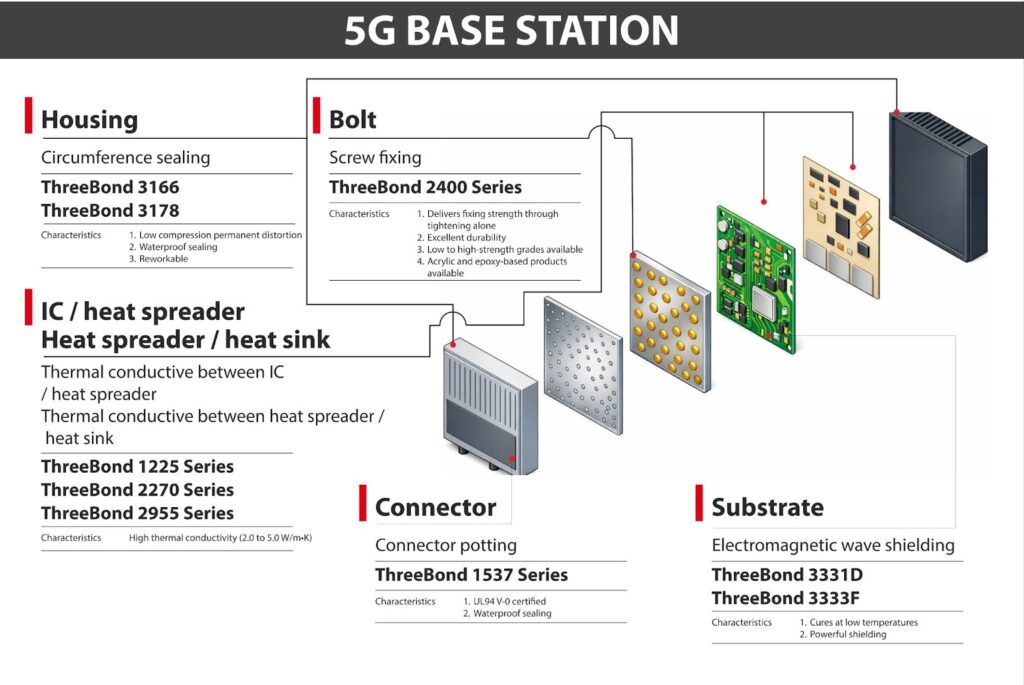
When designing semiconductor modules, engineers can leverage ThreeBond’s portfolio to address diverse needs. For thermal management, use thermally-conductive silicone adhesives (e.g. TB1225 or TB1225C) to bond heat spreaders or TIMs. For structural bonding, choose low-temperature curing epoxies (22INX022 series) to attach delicate components without damage. In high-temperature zones (power electronics), high-temperature curing epoxies (22INX018, 221NX021) form ultra-strong bonds and withstand heat. For sealing housings, select RTV silicone sealants with proven chemical and vibration resistance.
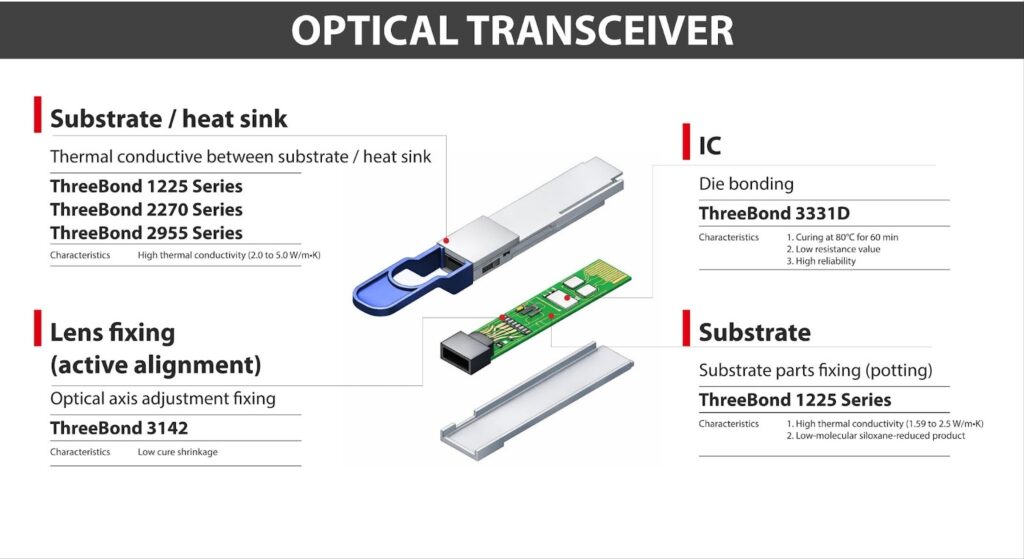
By incorporating ThreeBond adhesives and sealants at the design stage, semiconductor manufacturers can enhance device performance and production yield. Proper placement of these materials – from die attach to final enclosure sealing – ensures optimized adhesion and protection. With ThreeBond’s expertise and targeted formulations, each semiconductor application benefits from tailored bonding solutions.
Adhesives for semiconductors and sealants for semiconductors are thus key enablers of modern chip technology. Whether bonding silicon dies, dissipating heat or sealing packaging, ThreeBond products deliver the reliability that semiconductor devices demand. This holistic approach to adhesives and sealants keeps electronic components connected and protected at every step.
Explore here the products from ThreeBond for semiconductors, electronic and electrical devices.


Post a comment