

Adhesives for Electronics Manufacturing: For Smart Devices
Modern electronic products rely on specialized adhesives for electronics manufacturing to secure tiny components, manage heat, and protect circuits. Unlike solder or mechanical fasteners, adhesives can bond dissimilar materials, fill gaps, and provide insulation or conductivity as needed. In practice, adhesives “join materials that would not bond on their own” and enable reliable, space-efficient assemblies. For example, conductive epoxies containing silver or copper particles can replace solder at PCB pads, while silicone potting compounds seal a board against moisture and vibration. This combination of bonding and protection is critical: without the right adhesive, devices could suffer failures like cracked solder joints, loose parts, or short circuits. In electronics from micro-sensors to high-speed motors, adhesives add strength, light weight, and environmental ruggedness that boost performance and reliability.
Advantages of Adhesives in Electronic Components Manufacturing
Adhesives offer several advantages in electronics over traditional joining methods. They enable miniaturization by bonding tiny chips, wires, or sensors without bulky hardware. Adhesives can also damp vibrations and absorb thermal stress, since flexible silicones and urethanes remain elastic over wide temperature ranges. In many assemblies, light-weight adhesives allow for thinner, more compact designs—ThreeBond notes that UV-curable sheet adhesives, for instance, help make smartphone modules “thinner and more sophisticated”. Compared to solder, adhesives can join dissimilar materials (metal, glass, plastic) without high-temperature soldering, and they eliminate cold solder joints. They can be applied as liquids or pastes for automated assembly, then cured rapidly (by heat or UV light) to speed production.
Key benefits include:
Versatile bonding: Adhesives bond metals, ceramics, glass, plastics, and composites in one process. Epoxy adhesives provide high-strength rigid bonds, ideal for permanent fixes, while flexible silicones relieve stress on mismatched materials.
Electrical control: Electrically conductive adhesives (ECAs) carry current where solder can’t, using metal fillers to bridge connections. Non-conductive adhesives insulate components and prevent shorts.
Thermal management: Thermally conductive adhesives transfer heat away from chips. For instance, ThreeBond’s TB1225 silicone adhesive (1.6–2.5 W/m·K) bonds power ICs to heat spreaders, keeping devices cool without shorting circuits.
Environmental protection: Potting epoxies and sealants encapsulate electronics, protecting against moisture, dust, chemicals, and shock. Many adhesives are formulated to be RoHS-compliant, low in VOCs, and halogen-free.
Process efficiency: UV-curing adhesives polymerize in seconds under UV light, enabling high-speed assembly of sensitive components like displays and lenses. Fast-curing formulations reduce cycle time, improving throughput.
By combining bonding with insulation or conductivity, adhesives can perform multiple roles at once. As one ThreeBond guide notes, electronics adhesives serve functions from “physical bonding to heat management to insulation”, which is hard to achieve with any other joining method.
Types of Adhesives for Electronic Devices
Choosing the right electronic assembly adhesive depends on the application’s needs. Common types include:
Epoxy adhesives: Rigid and high-strength, two-part or heat-curable epoxies are workhorses in electronics. They bond well to ceramics and metals and resist chemicals. For example, ThreeBond’s TB2212B is a one-component heat-curable epoxy used in phones and computers; it cures at just 80–150 °C and gives excellent electrical insulation. Two-part epoxies offer gap-filling and very high bond strength, suitable for potting entire modules.
Silicone adhesives: Highly flexible and temperature-tolerant, silicone-based adhesives absorb thermal cycling and vibration. They remain elastic from –50 °C to over 200 °C, making them ideal for potting or gap-filling components subject to heat or flex. ThreeBond’s silicone adhesives (e.g. the 1225 series) even provide enhanced thermal conductivity for bonding heat sink].
UV-curing adhesives: These adhesives cure in seconds under ultraviolet or visible light, offering rapid assembly and optical clarity. UV adhesives are perfect for bonding transparent parts (touchscreens, camera lenses, cover glass) without leaving a visible joint. For instance, ThreeBond’s TB3020 series UV adhesives bond cover glass to displays with high strength and transparency.
Conductive adhesives: Filled with silver, copper, carbon or graphite, conductive adhesives create electrical paths. They can replace solder for attaching chips or repairing traces on PCBs. ThreeBond’s 3300-series electro-conductive resins are silver-particle epoxies used for EMI shielding or grounding connections. Non-conductive adhesives (standard epoxies or silicones) are used when insulation is needed.
Cyanoacrylate (“super glue”): Fast-setting and user-friendly, cyanoacrylate adhesives bond rigid parts quickly. While brittle, they are useful for small parts and repairs on circuit boards.
Each adhesive chemistry has trade-offs: epoxies cure hard and offer high strength, but little elasticity. Silicones cure soft and flexible but are not as strong. UV adhesives cure very fast and clear, but require light access to the glue line Choosing among them requires matching the adhesive’s electrical, thermal, and mechanical properties to the component’s requirements.
Applications & Challenges
Adhesives for electronics are used throughout the manufacturing process – from bonding tiny chips on a PCB to assembling large smart devices and motors. Some key application areas include:
PCB Assembly and Component Bonding: During wave-soldering or reflow, adhesives may temporarily hold small surface-mount parts in place. After soldering, potting epoxies or silicones are used to encapsulate and seal boards against moisture and shock. Gap-filling adhesives join heat sinks to power ICs (using thermally conductive adhesives like TB1225.
Conductive adhesives can also connect a PCB to its metal enclosure for grounding. In sum, adhesives in PCBs prevent loose parts, provide insulation, and improve durability.
Motors and Generators: Electric motors require adhesives to bond coils, fix magnets on rotors, and insulate windings. High-temperature epoxy adhesives (heat-resistant and insulating) ensure components stay intact under motor heat. For example, epoxy adhesives can “prevent electrical current leakage” and maintain structural integrity under vibration. Fast-curing or flexible epoxies are used when motors experience frequent temperature swings or mechanical stress. As ThreeBond notes, electric vehicles and industrial motors rely on advanced epoxy adhesive technology to boost performance and durability.
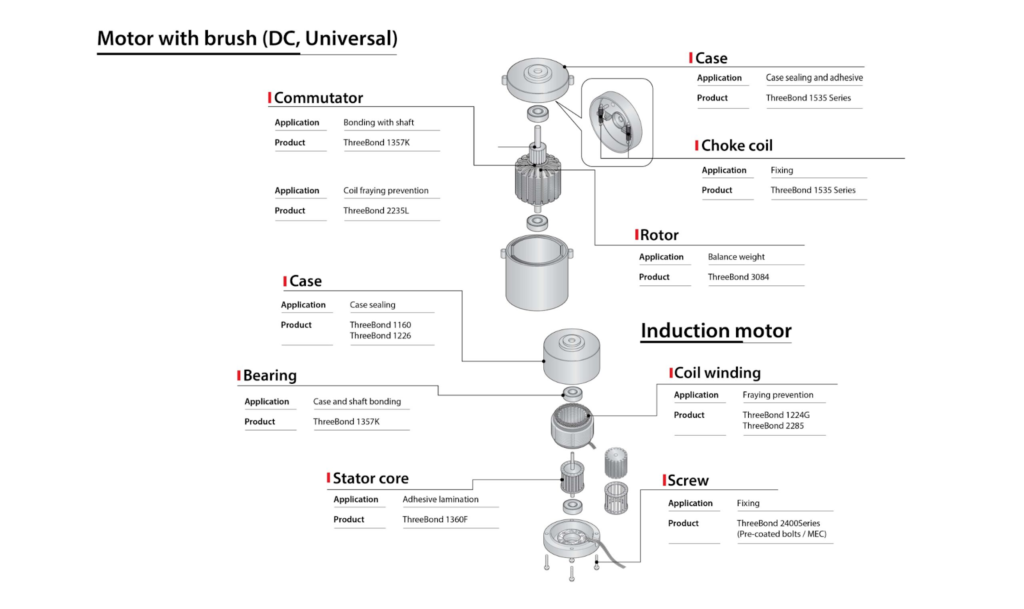
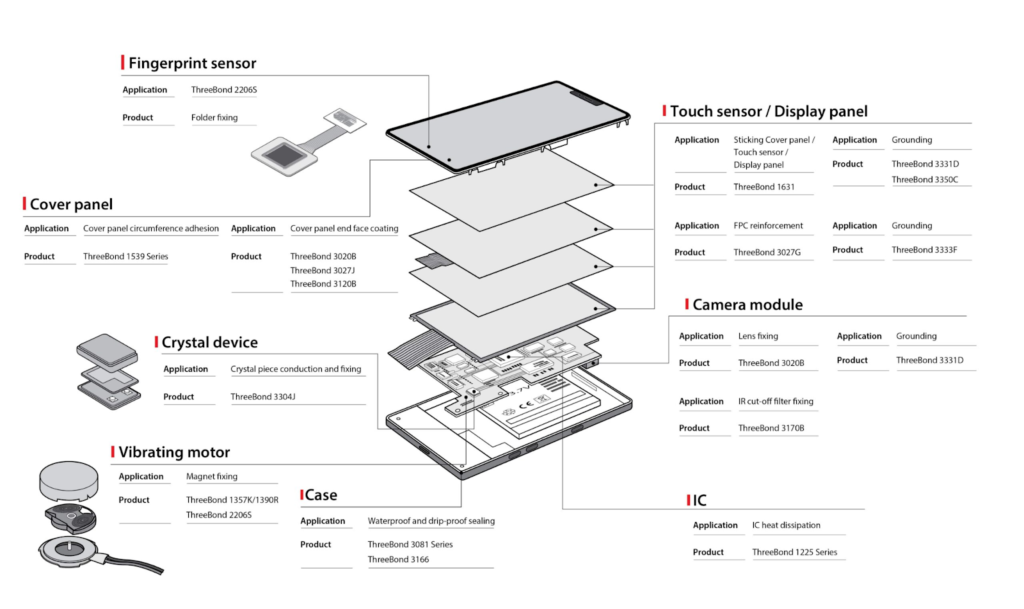
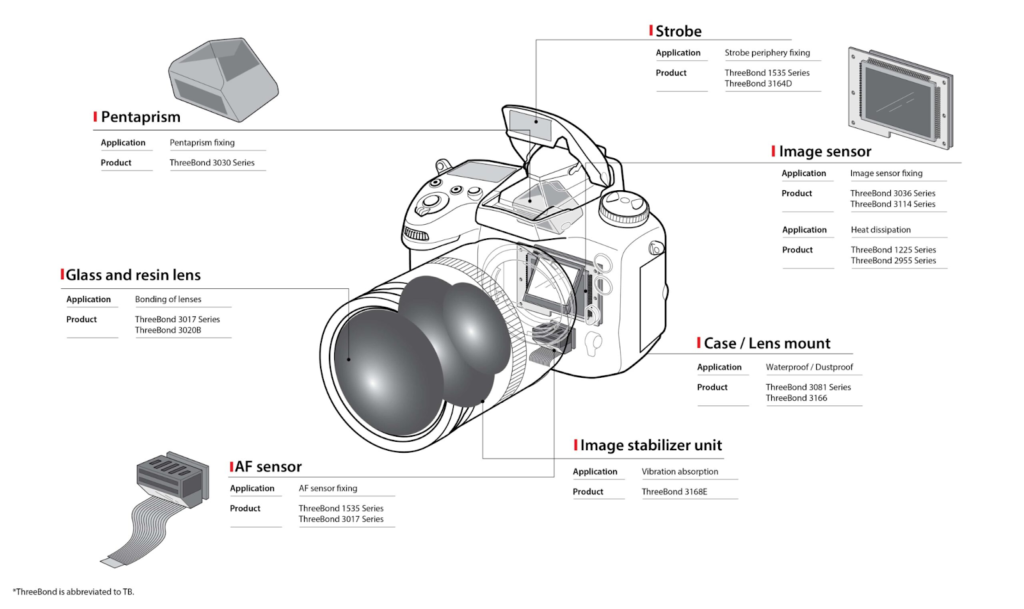
Sensors and MEMS Devices: Sensors (from simple MEMS accelerometers to complex camera modules) often incorporate adhesives for bonding tiny optical and electronic components. Specialized adhesives ensure dimensional stability and environmental protection without interfering with sensor accuracy. ThreeBond highlights that adhesives for sensors and MEMS must deliver “high reliability”. For example, low-outgassing epoxies prevent contamination in sensitive sensor cavities, and UV-curable adhesives enable precise bonding of lens elements in cameras.
Consumer Electronics (Smartphones, Cameras, Wearables): Modern gadgets are packed with glued joints. Smartphone assembly uses UV-curing adhesives to attach cover glass to touchscreens and seal the housing for waterproofing. Tiny camera modules rely on fast-curing, low-temp adhesives (e.g. TB1539, TB3027 for touch sensors; TB3170B for IR filters) to align lenses and sensors. Wearables like smartwatches use adhesives that can be applied in ultra-thin layers to bond miniature parts while withstanding impact and sweat.
Optical and Communication Devices (5G, Fiber Optics): High-speed communication hardware demands adhesives that can handle heat and precision. Adhesives in optical transceivers and base stations must bond delicate photonic components without blocking signals. UV-curable resins and thermally conductive adhesives are used to fix fiber optics and heat sinks. The global rollout of 5G networks is increasing demand for adhesives that improve thermal management in broadband routers and servers.
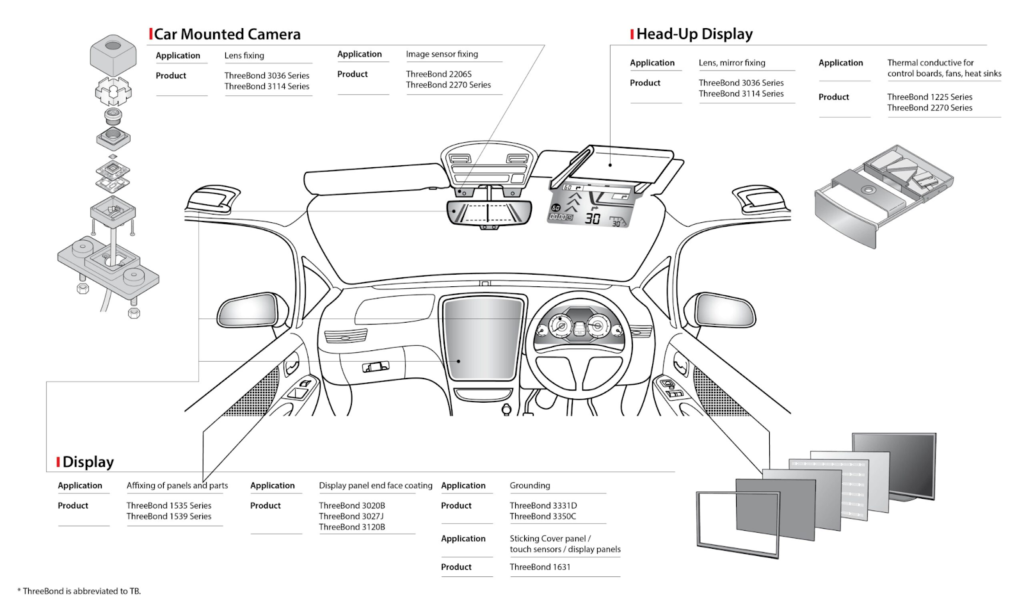
Automotive Electronics: On-board cameras, displays, and sensors in cars must survive harsh conditions. Adhesives used in automotive assemblies require higher heat resistance and reliability. ThreeBond develops adhesives for vehicle infotainment and ADAS (advanced driver assistance) systems, such as UV-curable adhesives for bonding lens to camera modules and sealants for display screens.
Challenges: While adhesives offer many benefits, they also introduce new challenges. Engineers must carefully select adhesives to match substrate materials (metals, plastics, ceramics) and operating conditions. For example, an adhesive chosen for high thermal conductivity might not adhere well to flexible PCB materials. Key factors include bond strength, cure temperature, curing time, thermal expansion, and chemical compatibility. An adhesive must not corrode copper traces or outgas onto optics. In high-speed electronics, excess adhesive or migration could affect signal integrity. There are also processing considerations: many epoxies require elevated temperatures, which could damage sensitive components; in such cases, low-temperature-curing or UV-curable adhesives are preferred.
Regulatory and environmental concerns add complexity. Electronics adhesives often need to meet RoHS and automotive standards, being free of halogens and low in volatile organic compounds. They must remain durable in harsh environments (automotive underhood temperatures, outdoor antenna weather, etc.). The trend toward miniaturization further strains adhesives: as components shrink, adhesives must provide the same performance in tinier volumes. In short, the challenges include matching every performance need—electrical, thermal, mechanical, and chemical—while enabling efficient manufacturing.
Adhesive Solutions and Key Features
Modern adhesive technologies offer solutions to these challenges with specialized chemistries and formats. Key solutions include:
Low-Temperature and Rapid Curing Adhesives: For heat-sensitive components (like thin LCDs or microchips), low-temperature curing epoxies (e.g. ThreeBond TB2212B) bond at 80–150 °. UV-curable and visible-light epoxies let manufacturers assemble parts at room temperature and cure them in seconds with light. This avoids thermal damage and speeds up production.
Thermally Conductive Adhesives: High-power circuits use thermally conductive silicones or epoxies (like TB1225 series) to wick heat away. Such adhesives can have thermal conductivities in the range of 1–5 W/m·K, moving heat from hot chips to metal heat sinks. This is critical in power electronics, LED lighting, and motor control units.
Electrically Conductive Adhesives: To create electrical interconnects without solder, silver-filled epoxies (e.g. ThreeBond’s 3300 series) are used. They can bond chips or create flexible circuits where reflow soldering is impractical. Conductive adhesives also provide EMI shielding when applied as a coating between a PCB and chassis.
Optically Clear Adhesives: In displays and cameras, adhesive clarity is essential. UV-transparent acrylic or epoxy adhesives are formulated to bond glass and plastic without yellowing. ThreeBond’s UV adhesives (TB3020/3010 series) are examples that cure transparently, preserving image quality in touchscreens and sensors.
High-Strength Structural Adhesives: Some assemblies (like bonding metal enclosures or ruggedized modules) need structural strength. Epoxy or acrylic adhesives with high tensile and shear strength are used. These often require mixing two components but yield permanent, tough bonds.
Moisture-Blocking Sealants: Silicone or polyurethane sealants are used around enclosures and connectors to block water ingress. For instance, low-temp sealants can “produce waterproof and drip-proof devices” in smartphones and motors.
Adhesive Tapes and Films: For certain applications (like attaching flexible circuits or laminating layers), pressure-sensitive adhesives (PSAs) and double-sided tapes are used. UV-curable adhesive films can attach display layers without liquid glue.
Many of these adhesives combine features to meet specific needs. For example, ThreeBond’s TB1539 and TB3027 are UV adhesives tailored to bond touch sensors, while TB1631 (urethane-based) is designed for laminating screens. TB3170B is a dual-cure epoxy used to attach IR filters in cameras. These product examples illustrate how companies match adhesive chemistries to function. In practice, engineers select an adhesive series by its key property: TB1225 silicone for thermal dissipation, TB2212B for low-temp circuit bonding, TB3300 conductive epoxy for grounding. Each adhesive solution is backed by data sheets and support to ensure it performs in the target application.
Key Features of Adhesives for Electronic Devices
Across all categories, electronics assembly adhesives share some key features:
Bond Strength & Durability: They form strong bonds that withstand mechanical stresses and environmental aging. High-strength epoxies ensure components stay fixed during vibration and shock.
Electrical Properties: Dielectric (insulating) adhesives protect high-voltage parts, while conductive adhesives create reliable electrical paths.
Thermal Stability: They maintain integrity over the device’s temperature range. Heat-resistant formulations (epoxy or silicone) resist softening or degradation at high temp.
Chemical Resistance: Many electronics are exposed to oils, solvents or humidity. Chemical-resistant adhesives prevent breakdown in harsh conditions.
Controlled Cure: Tailored curing profiles (UV, heat, moisture) give process flexibility. Fast curing boosts throughput; slower cure adhesives may allow better part alignment.
Low Outgassing: Especially important in optics and aerospace electronics, adhesives are formulated to minimize volatile emissions.
Compatibility: Good wetting and adhesion to plastics, metals, glasses, and PCB laminates. Also matching thermal expansion properties to avoid stress.
Regulatory Compliance: As noted, many adhesives are formulated to meet RoHS, UL, FDA or automotive standards. Low-smoke, non-halogen options are common.
Viscosity and Application: Fluids, thixotropic pastes, or films allow adhesive dispensing by syringe, jet, or roller. Precise placement (micro-dispensers or printed adhesives) is a trend.
By integrating these features, modern adhesives address the specialized needs of electronic components. For example, a formula might combine high optical clarity with UV cure speed for display bonding, or pair flexibility with thermal conductivity for LED assembly.
Trends & Adhesive Technology
The electronics adhesive market is growing rapidly. According to industry forecasts, it was valued at about $4.5 billion in 2022 and is projected to reach $6.1 billion by 2027 (CAGR ~6.1%). This growth is fueled by several trends:
Miniaturization & Automation: As devices become smaller, bonding tiny components reliably is paramount. Automated application of adhesives (e.g. robotic dispensing or roll-coating) is on the rise. The market research notes that demand for compact mobile devices, touchscreens, and medical electronics is driving adhesive consumption.
Thermal and Electrical Demands: High-performance chips and power electronics generate more heat, so thermally conductive adhesives are one of the fastest-growing segments. Likewise, high-frequency circuits (5G/optical) push adhesives to have better dielectric properties and lower signal loss.
Transition from Solder: Environmental regulations and miniaturization are shifting manufacturers from solder to adhesives in some applications. North American electronics assemblers increasingly prefer no-lead adhesives over traditional solder for fine-pitch and flex circuits.
Expansion of IoT & 5G: The spread of IoT devices and 5G infrastructure creates new markets for adhesives. For instance, adhesives that join fiber-optic components or bond sensors in drones require very precise, reliable formulations.
Electrification & EVs: Electric vehicles and renewable energy systems require adhesives for battery packs, power converters, and motors. High-temperature and insulating adhesives are becoming more important in automotive and energy sectors.
Green & Smart Materials: There’s growing demand for eco-friendly, low-VOC adhesives and for ones compatible with new materials (like flexible PCBs, 3D-printed substrates). Additionally, “smart” adhesives that change color or conductivity under conditions (for monitoring) are an emerging research area.
Overall, adhesive technology continues evolving with electronics. New formulations (e.g. UV-LED curable, nanoparticle-enhanced adhesives) and smart dispensing methods (inkjet-printed conductive adhesives, for example) are part of this innovation wave. By staying aligned with these trends, adhesive manufacturers like ThreeBond aim to supply next-generation electronic assembly adhesives that meet tomorrow’s challenges.
Conclusion
From precision sensors to high-torque motors, adhesives are critical enablers in modern electronics manufacturing. They secure and protect components in ways no other method can, enabling smaller, faster, and more reliable devices. By matching the right adhesive chemistry – whether a heat-resistant epoxy, a UV-curing optical glue, or a silver-filled conductive resin – engineers can solve assembly challenges and improve product durability.
ThreeBond offers a broad portfolio of electronics-grade adhesives tailored to these needs. Their products exemplify key features needed in electronics assembly. For example, TB1225 silicone adhesives provide high thermal conductivity for heat sinks, while TB2212B epoxy bonds fragile circuits at low temperature. These specialized solutions, combined with technical support, help manufacturers meet both traditional and emerging demands in the adhesives for electronics market.
Explore ThreeBond’s electronics adhesive solutions to find the right product for your manufacturing challenges – whether you’re building motors, smart devices, or cutting-edge sensors. Our experts can help you select the best adhesive for bonding, sealing, or potting your components.
Contact ThreeBond India today to learn how our adhesives can boost the performance and reliability of your electronic products.
Frequently Asked Questions
Q: What kinds of adhesives are used in electronics manufacturing?
A: Many kinds. Common choices include epoxy adhesives (for high-strength bonding and potting), silicone adhesives/sealants (for flexibility and temperature resilience), UV-curable adhesives (for fast, clear bonds on displays and optical parts), and conductive adhesives (filled with metal particles for electrical connections). Instant cyanoacrylates and polyurethane glues are also used for quick fixes and flexible joints, respectively.
Q: Why use adhesives instead of solder or mechanical fasteners?
A: Adhesives can bond disparate materials (plastic to metal, glass to PCB) without special surface prep, and they add sealant and protection that solder can’t. They allow electronics to be lighter and smaller by eliminating bulky clips or screws. For example, a conductive epoxy can replace solder to connect chips on a board, while an epoxy potting compound will insulate and protect the entire assembly from shock.
Q: What is UV curing adhesive and when is it used?
A: A UV curing adhesive is a glue that rapidly hardens when exposed to ultraviolet light. In electronics, UV-curable adhesives are prized for bonding transparent parts (like screens and lenses) because they cure in seconds and remain optically clear. They are used to laminate display cover glass, attach camera lenses, or secure transparent sensor covers, enabling quick assembly with precision.
Q: How are adhesives used in electric motor assembly?
A: Electric motors use adhesives to bond coils, secure permanent magnets, and insulate components. Specialized epoxy adhesives provide high-temperature resistance and electrical insulation inside motors. For example, heat-resistant epoxy keeps its bond under the high heat of a running motor, and insulating epoxy prevents shorts between windings. Flexible epoxies also help accommodate thermal expansion and vibration. Overall, adhesives enhance motor reliability and efficiency by maintaining component integrity under harsh conditions.
Q: What special adhesives are used for sensors and MEMS devices?
A: Sensor assemblies often require adhesives that are low-outgassing, ultra-precise, and vibration-resistant. UV or low-temp epoxies are common for bonding tiny MEMS components without thermal stress. ThreeBond, for instance, emphasizes adhesives optimized for “high reliability” in sensor and MEMS applications. These adhesives must not shift position over time and often need to withstand temperature and humidity changes without affecting sensor accuracy.
Q: What factors should engineers consider when selecting an adhesive?
A: Engineers evaluate substrate compatibility (will it stick to your materials?), curing process (heat, UV, room-temp), thermal/electrical requirements, and mechanical demands (rigidity vs. flexibility). They also check environmental specs: the adhesive’s glass transition temperature, thermal conductivity, dielectric strength, and resistance to moisture or chemicals. Regulatory compliance (e.g. RoHS) may require halogen-free formulas. In essence, the “best adhesive” is the one whose chemical properties match the application’s electrical, thermal, and structural needs.
Q: How do conductive adhesives benefit circuit design?
A: Conductive adhesives allow electrical connections without solder. They can bond heat-sensitive components or create flexible circuits where soldering would be too harsh. By loading an epoxy with silver or carbon, these adhesives maintain conductivity (often 70–90% of solder. They are used for grounding or EMI shielding too – for example, a conductive epoxy can bond a PCB to its metal chassis to ground the board. This adds design flexibility and often improves reliability in vibration-prone assemblies.


Post a comment