

Medical Device Adhesives: Types, Key Properties and Product Solutions for Manufacturers
Reading Time: 10 minutesIn the medical device industry, adhesives play a crucial role in bonding and sealing components. From catheters and syringes to diagnostic kits and infusion sets, medical equipment often incorporates specialized medical-grade adhesives to ensure precision and patient safety. These adhesives must meet stringent requirements – for example, ThreeBond’s medical-grade formulations adhere to ISO 10993 biocompatibility standards – so that bonded parts in contact with fluids or tissues remain safe. In this blog, we’ll explore the types of medical device adhesives, their key properties and considerations, and product solutions (including ThreeBond’s offerings) that manufacturers use to build safe, reliable equipment.
Types of Medical Device Adhesives
Medical device Adhesives manufacturers use a variety of adhesive chemistries depending on the application. Common categories include:
● Epoxy Resins: Two-part epoxies provide strong, structural bonds and excellent chemical and heat resistance. ThreeBond’s epoxy adhesives (e.g.
TB2086M, TB2202C) boast powerful adhesive strength and can cure at low or high temperatures as needed. These are used for bonding metal or hard plastics in applications like sensor housings or instrument casings.
● Instant (Cyanoacrylate) Adhesives: Single-component cyanoacrylate adhesives set in seconds without solvents. They work on a wide range of substrates (metal, glass, many plastics) and can be formulated with primers to bond difficult materials like polypropylene. ThreeBond’s instant adhesive products (such as TB1771M, TB1773E) deliver rapid curing and high bond strength for quick assembly of disposable tools or components.
● UV-Curing Adhesives: UV/UV-LED curable acrylates or epoxies cure in seconds under light, making them ideal for high-volume medical disposables. These adhesives (e.g. ThreeBond’s TB3094 series) offer strong bonds to metals and plastics and fast processing. For example, the ThreeBond 3094J resin is a high-reactivity UV-curable adhesive with reduced shrinkage, specifically developed for medical device assembly. UV-curable adhesives are often used in bonding infusion sets, catheter components, and other parts where speed and precision are critical.
● Elastomeric (Silicone/Polyurethane) Adhesives: One-component, moisture- curing elastomers form flexible, durable seals. They are solventles and safe (DBT-free, tin-free). Silicone-based elastomeric adhesives (e.g. TB1533F, TB1535C) are widely used to seal tubing, gaskets or enclosures where flexibility and biocompatibility are important. These adhesives cure into rubber-like elastomers that absorb stress and accommodate vibration in medical instruments.
Each type of adhesive is chosen for its unique combination of workability and performance in medical applications. The above categories cover most medical bonding needs, from rigid structural joints to flexible seals.
Key Properties and Considerations for Medical Device Adhesives
When selecting adhesives for medical devices, manufacturers weigh many key properties:
● Biocompatibility & Safety: Medical adhesives often contact bodily fluids or tissues (directly or indirectly). Thus they must meet biocompatibility standards such as ISO 10993 or USP Class VI. For example, ThreeBond’s adhesives are formulated to comply with ISO 10993 testing, giving confidence that the cured adhesive will not leach toxic substances into the body. In practice, a “medical- grade” adhesive has been tested under these standards and shown to produce no adverse cellular or tissue reaction. Low toxicity and absence of harmful by- products are paramount for patient safety.
● High Bond Strength and Durability: Medical devices often undergo handling, sterilization, and stress. Adhesives must form robust, reliable bonds. ThreeBond cites example adhesives (like TB2202C and TB1771M) that provide “strong adhesion” and long-term reliability. Critical joints – such as a needle bonded to its hub – require adhesives with excellent tensile and shear strength. The adhesive’s peel and shear resistance should withstand the expected loads over the device’s lifetime.
● Cure Speed and Workability: Fast curing reduces cycle time and costs. Cyanoacrylates and UV-curable adhesives bond in seconds, which is ideal for high-volume disposable items. For instance, UV-LED curable resins in the ThreeBond 3094 series can fully cure in a fraction of a second under a 365 nm LED. Rapid cure also minimizes thermal exposure to heat-sensitive parts, since some adhesives (like TB2202C) are designed to cure rapidly at low temperatures. Primers and activators may be used to speed curing or to help bond stubborn plastics.
● Chemical and Thermal Resistance: Medical adhesives often encounter sterilization (autoclave, ethylene oxide, gamma irradiation) and exposure to body fluids or cleaning agents. High chemical resistance ensures the bond won’t degrade. ThreeBond highlights that its adhesive formulations offer “exceptional chemical resistance” to medical fluids. Adhesives must also resist heat during device operation or sterilization; some epoxies and silicones maintain bond integrity at elevated temperatures. If the device is implanted or internal, the adhesive must not soften or leach under body temperature and conditions.
● Flexibility vs. Rigidity: Depending on the application, an adhesive may need to be elastic or rigid. Elastomeric silicones stay flexible to accommodate motion (useful in tubing or seals), while rigid epoxies create solid structural bonds (useful in electronics or optical assemblies). The adhesive’s modulus (hardness) must match the mechanical requirements of the bond without cracking or stressing the substrates.
● Other Factors: Low shrinkage is important for precision assemblies – for example, the ThreeBond 3094J UV resin was developed specifically for reduced shrinkage in medical device bonding. Non-yellowing and clarity are important for optical devices or transparent components. “Low outgassing” is a consideration if adhesives are used in vacuum or sensitive electronics to avoid contamination. In short, manufacturers must choose adhesives based on all these factors – many of which are summarized in ThreeBond’s product literature.
In summary, the ideal medical adhesive combines biocompatibility, high strength, fast cure, and environmental resistance. ThreeBond’s adhesives, for example, are engineered with these characteristics in mind, supporting safe medical device design.
Applications of Medical Device Adhesives
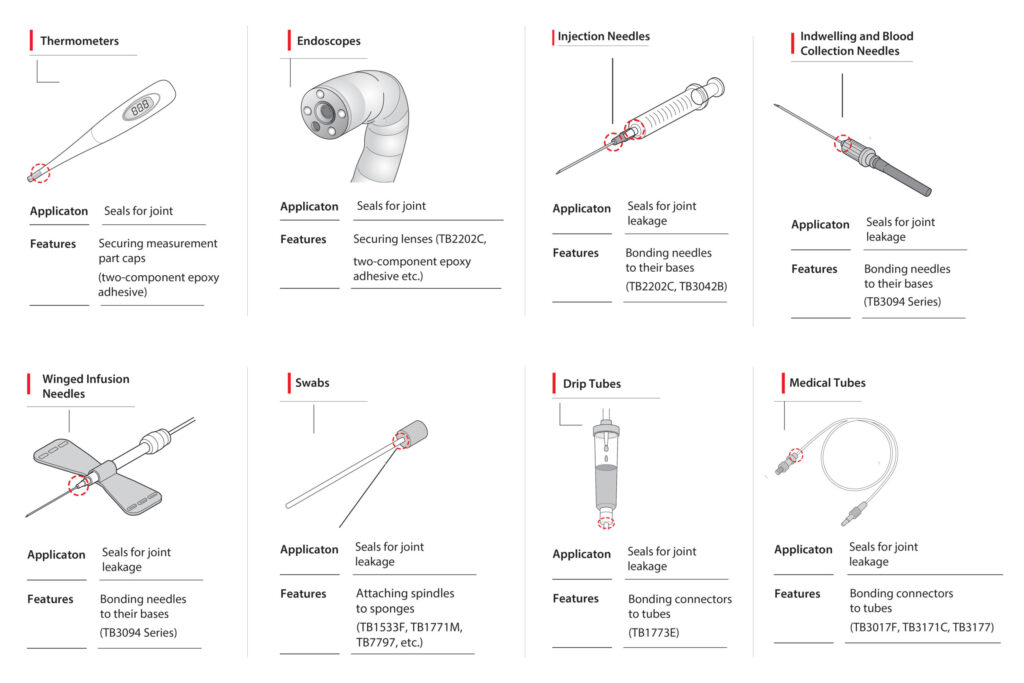
Adhesives are used in a wide range of medical device components and products. Some typical applications include:
● Injection Needles and Syringes: Securing the needle to its plastic hub or base is critical for safety. ThreeBond’s adhesives like TB2202C and TB3042B provide robust adhesion for this joint. TB2202C, for example, is ISO 10993-compliant and cures quickly even at low temperatures, ensuring a strong, reliable bond in needle assemblies.
● Diagnostic Swabs & Sample Kits: Cotton or synthetic swab tips must be attached to plastic or metal applicator sticks. Fast-setting cyanoacrylates (e.g. ThreeBond TB1771M) are used to bond the fiber tip onto the swab shaft, ensuring it won’t detach during use. TB1771M has light-curing capability for precise placement and quick bonds.
● IV Tubing and Catheters: Flexible tubes and connectors must form leak-proof, biocompatible seals. UV-curable adhesives (like ThreeBond’s TB3094 series) or instant adhesives (TB1771M) are used to seal joints in drip tubes and catheters. For example, ThreeBond notes that TB1771M gives “leak-proof and durable connections” for IV drip tube assemblies. The ability to bond quickly without heat is advantageous for mass-producing disposable infusion sets.
● Device Housings and Enclosures: Many electronic medical devices (monitors, pumps, meters) have plastic or metal housings sealed by silicone or epoxy adhesives. Elastomeric adhesives (e.g. TB1533F) provide flexible, durable seals around enclosures to protect internal electronics and prevent liquid ingress. Rigid adhesives are used inside to bond components onto PCBs or to pot sensors and protect them from moisture.
● Glass and Optical Components: In devices like endoscopes or diagnostic instruments, clear adhesives (UV-curable or epoxy) are used to bond glass or transparent plastics. UV-curable optical-grade adhesives allow fast assembly of lenses or optical fibers without adding color. While not explicitly listed in ThreeBond’s site, medical optics often require low-outgassing, non-yellowing adhesives.
● Wearable/Transdermal Patches: Though not covered in our references, some medical device adhesives are designed to stick to skin (e.g., patient monitoring sensors or bandages). These must be gentle and hypoallergenic. (ThreeBond’s portfolio focuses on adhesives for equipment rather than skin adhesives, but similar biocompatibility principles apply.)
Each of these applications leverages adhesives that meet the specific demands of the component. As ThreeBond illustrates in case examples, adhesives are critical in needle-to-base bonds, fluid delivery tubing, and instrument assembly. By choosing the proper adhesive (as detailed above), manufacturers ensure that the final medical device performs reliably and safely in use.
ThreeBond’s Medical-Grade Adhesive Solutions
ThreeBond offers a comprehensive range of medical-grade adhesives tailored to equipment manufacturing. All ThreeBond medical adhesives are formulated to ISO 10993 biocompatibility standards. So they are safe for devices that may contact medical fluids. Their product lineup covers the types discussed above and includes:
● Epoxy Adhesives: Products like TB2202C and TB2086M provide strong, durable bonds with excellent chemical resistance. TB2202C is notable for strong adhesion and fast curing at low temperatures. These epoxies are ideal for bonding metal parts, structural frames, and components that require heat or chemical resistance.
● Instant (Cyanoacrylate) Adhesives: ThreeBond’s cyanoacrylates (e.g. TB1771M, TB1773E) cure in seconds and form hard bonds on plastics and metals. TB1771M in particular is a versatile, light-curing adhesive that ThreeBond highlights for swab and tube assemblies. For plastics like
polypropylene, ThreeBond provides primers (such as TB7737) that allow even these “difficult” materials to be securely bonded.
● UV-Curing Resins: The TB3094 series and TB3017F are UV-curable adhesives that bond rapidly under UV or UV-LED light. ThreeBond’s latest UV resin, 3094J, was developed with a new formula for reduced shrinkage and higher reactivity. This means TB3094J cures faster and causes less stress on the parts than earlier formulas. Such UV adhesives enable high-throughput production of disposables (needles, catheters, test kits) with precise, stable bonds. ThreeBond also notes that these resins are compatible with energy-efficient UV-LED curing, aligning with modern manufacturing.
● Elastomeric (Silicone) Adhesives: Products like TB1533F, TB1535, and TB1539B are one-component, moisture-curing silicone adhesives. They bond a variety of substrates while providing flexible, rubber-like seals. Being solventless, they are safe for workers and equipment. These silicones cure into elastic adhesives used for sealing tubes, valves, or enclosures in medical devices. ThreeBond highlights that these formulations are DBT-free and tin-free, enhancing biocompatibility.
In all cases, ThreeBond’s medical adhesives emphasize high performance and reliability. The company points out that its adhesives offer exceptional strength and resistance for medical manufacturing, and that they are trusted by equipment makers worldwide. For example, the adhesives support UV-LED curing to save energy without compromising bond quality. Whether bonding tiny components in a disposable kit or
sealing a plastic housing on a vital instrument, ThreeBond provides technical support and a range of products to meet those needs.
Ensuring Patient Comfort and Safety
Advanced adhesive technology contributes directly to patient comfort and safety. Because medical-grade adhesives are tested for biocompatibility, they minimize the risk of toxicity or irritation if a bonded component contacts bodily fluids. Fast, precise bonding also reduces manufacturing defects: for instance, a stronger needle-hub bond means fewer device failures in use, directly impacting patient safety. Likewise, low- shrinkage UV adhesives (like TB3094J) prevent stress on delicate parts, preserving device accuracy and comfort.
Furthermore, solvents-free formulations (instant adhesives and silicone sealants) reduce volatile exposure for patients and healthcare workers. By eliminating or greatly reducing outgassing and odorous chemicals, ThreeBond’s solventless adhesives enhance the cleanliness of the final product. Flexible silicones contribute to comfort by allowing movements in hoses or wearable devices without detachment or rupture.
In summary, the technology behind medical adhesives – fast UV curing, low-toxicity chemistry, and strong, reliable bonds – all supports safer, more effective medical devices. As ThreeBond notes, their advanced adhesives help manufacturers produce equipment that “supports the healthcare industry’s mission to save lives and improve well-being”. Choosing the right adhesive solution is therefore a key step in delivering quality patient care.
Conclusion: Medical device adhesives are specialized products designed to bond and seal critical equipment components safely and durably. Key considerations – biocompatibility, bond strength, cure speed, and resistance to chemicals and sterilization – guide adhesive selection for each application. ThreeBond India offers a full spectrum of medical-grade adhesives (epoxies, cyanoacrylates, UV-resins, silicones) that meet ISO 10993 standards and the rigorous demands of device assembly. These products (such as TB2202C, TB1771M, TB3094 series, and TB1533F) provide manufacturers with solutions tailored to injection needles, tubing, housings, and more. By leveraging such advanced adhesive technologies, medical device manufacturers can ensure their products are reliable, efficient, and, above all, safe for patients.
Frequently Asked Questions
Q1: What qualifies an adhesive as “medical-grade”?
A: A medical-grade adhesive is formulated and tested for use in medical devices. Such adhesives must pass biocompatibility tests (e.g. USP Class VI or ISO 10993) to ensure they do not cause toxic or adverse effects when in contact with the body. In practice, this means the manufacturer has documented safety testing (cytotoxicity, sensitization, etc.) to regulatory standards. Medical-grade status typically implies high purity (solventless where possible) and proven safety in device assembly.
Q2: What are common types of adhesives used in medical devices?
A: Common medical device adhesive types include epoxies, cyanoacrylates (instant glue), UV/LED-curable adhesives, and silicone (elastomeric) adhesives. Epoxies provide very strong, heat-resistant bonds. Cyanoacrylates cure in seconds without heat. UV-curable acrylates bond rapidly under light, enabling high-speed assembly. Silicone/elastomers cure into flexible seals and are often used for tubing or enclosure gaskets. Each type is chosen based on bond strength, flexibility, and processing requirements.
Q3: Why is biocompatibility important for medical adhesives?
A: Because medical adhesives may contact patients (through fluids or implants), they must be safe. Biocompatibility testing ensures that the cured adhesive does not leach harmful substances or cause tissue irritation. For example, ISO 10993 standards (widely used globally) include tests for cytotoxicity, sensitization, and more. Using an ISO 10993-compliant adhesive (as ThreeBond’s products are) ensures that any traces of the adhesive that encounter the patient will not induce toxicity, which is critical for patient safety.
Q4: How do UV-curing adhesives benefit medical device manufacturing?
A: UV-curable adhesives cure in seconds when exposed to UV or UV-LED light. This rapid curing dramatically speeds up production of disposable medical devices (like syringes, kits and sensors). UV adhesives also typically have very high bond strength and low shrinkage. ThreeBond’s UV resin (TB3094 series) cures quickly even with a 365 nm UV-LED, and the newer 3094J formulation has reduced shrinkage and higher reactivity. In practice, UV adhesives enable energy-efficient, high-throughput manufacturing with precise, durable bonds in medical components.
Q5: What are examples of ThreeBond adhesives for medical devices?
A: ThreeBond offers a range of medical equipment adhesives. For example, TB2202C is an ISO 10993-compliant epoxy adhesive used for bonding metal or plastic components (like needle hubs). Instant adhesives like TB1771M and TB1773E are cyanoacrylates that cure in seconds for general assembly. The TB3094 series (including TB3094J) are UV-curable resins for high-speed bonding of needles andtubing. For sealing applications, silicone elastomeric adhesives such as TB1533F and TB1535 cure to form flexible, durable seals. Each of these products is tailored to medical use, providing strong bonds, fast curing, and biocompatibility for device manufacturers.



Post a comment